


Acupuncture and Pain Management

January 27th, 2010 by Acuhealer

It may be hard to believe that the shallow insertion  of very thin,  disposable, stainless steel needles at selected acupuncture points on the body would actually reduce or eliminate pain. How could this be? The good news is, not only does acupuncture relieve pain, it is healing modality; oftentimes healing injuries and eliminating pain that is associated with them. Read the rest of this entry »

Needles & Nerves

April 2nd, 2009 by Julie Silver

by Catherine Dold

Five years ago, while visiting his native Korea, physicist Zang-Hee Cho took a tumble down a hiking trail. “We were in the mountains for a picnic, and my shoes were not quite correct,” recalls the 62-year-old professor from the University of California at Irvine. “I was thinking, as usual, and I fell down. It was like a flight, like a big jump down the mountain. The next day I returned to California and tried to stand up after 12 hours on the plane. I couldn’t stand up. I said, ‘Uh-oh, big trouble.’”

Eventually, Cho hobbled off the plane and made his way home, and later he began to look for some relief from the pain in his back. Relatives suggested he try acupuncture. Though he initially scoffed at the idea-as an educated person, he says, he didn’t believe in acupuncture-he tried it. And much to his surprise, it worked. “After about ten minutes I felt the pain melting away.”

Cho’s unexpected relief prodded his professional curiosity. As a physicist working in radiology, Cho develops ways to image the complex inner workings of the body; one of his inventions was a prototype PET scanner around 1975. How, he wondered, could inserting needles into seemingly random points on the body possibly affect human health? So he decided to take a closer look, and what he found astounded him. While sticking needles into a few student volunteers, he took pictures of their brains and discovered that by stimulating an acupuncture point said to be associated with vision-but that is nowhere near anything known to be connected to the eyes-he could indeed trigger activity in the very part of the brain that controls vision. There just might be something to this acupuncture thing, he figured.

Acupuncture and other forms of traditional Chinese medicine have been around for more than 4,000 years. Yet the explanation for how acupuncture-and Chinese medicine as a whole-works has long been a mystery, if not an object of mockery, for most Western doctors. The basic theory is outlined in a text from 200 B.C., attributed to the Yellow Emperor (a mythical ruler). In brief, it recognizes in people and in nature a vital energy or life force known as qi (pronounced chee). Qi is the source of movements ranging from voluntary muscle action to blood flow; it protects the body from external influences, and it generates warmth. Qi flows through the body and to the organs by way of an extensive system of channels known as meridians. If the flow of the force is disturbed, the theory goes, the resulting deficiency, excess, or stagnation of qi causes bodily malfunction and thus illness. Acupuncture, in which needles are inserted into specific points along the meridians and manipulated, is said to restore the proper flow of qi and thereby return the body to health.

Practitioners recognize some 1,500 acupoints, most of which have no obvious relationship to their intended targets. For example, a point on the second toe is used to treat headaches and toothaches, while a point near the elbow enhances the immune system. Unlike Western medicine, in which many complex functions are understood to be controlled by interactions in the brain, traditional Chinese medicine holds that there is little connection between the brain and various organs and that stimulating an acupoint sends a message directly to the targeted organ.

Another integral concept is the tension between two ever-present, complementary forces of nature, yin and yang. When their balance is disturbed, the theory goes, people get sick. Yin conditions reflect a lack of qi: pale face, cold extremities, slow pulse, depression. Yang conditions result from an excess of qi: red face, fever, fast pulse, agitation.

Doctors and licensed practitioners administer between 9 and 12 million acupuncture treatments each year in this country, most commonly for pain control and addictions to nicotine, heroin, and cocaine. As acupuncture has gained favor among Westerners, researchers have sought to unveil its mysteries. They want to understand just how this ancient medical practice could possibly work, especially when no Western researchers have ever been able to dissect a meridian or detect the flow of qi.

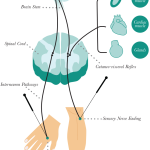
What those researchers have been able to measure is a flow of acupuncture-induced endorphins. According to neuroscientist Bruce Pomeranz, of the University of Toronto, numerous studies over the past 20 years have shown that inserting needles into acupoints stimulates nerves in the underlying muscles. That stimulation, researchers believe, sends impulses up the spinal cord to a relatively primitive part of the brain known as the limbic system, as well as to the midbrain and the pituitary gland. Somehow that signaling leads to the release of endorphins and monoamines, chemicals that block pain signals in the spinal cord and the brain. The result: A well-documented generalized “acupuncture analgesia.”

“The endorphin story is really nailed down,” says Pomeranz. “It looks like it’s nerves to the brain. The acupoints that have been mapped over thousands of years are likely the spots where nerves are concentrated.” But the endorphin story “doesn’t explain many of the other claims of acupuncture,” he continues. “There have been a number of clinical trials showing that acupuncture is extremely useful for the nausea and vomiting caused by chemotherapy and early pregnancy. That’s not the endorphin system. Nobody knows how that works.”

Nor does the endorphin story explain what Cho found when exploring acupoints that are traditionally used to treat vision problems. Designated by Cho as VA1, VA2, VA3, and VA8, they are not found near the eyes but on the outside of the foot, running from the little toe to the ankle. The “VA” in Cho’s designation is for “vision-related acupoint.” Acupuncturists say that these points are on the urinary bladder meridian and refer to them as BL67, BL66, BL65, and BL60, respectively. And they hold that stimulation of these points with needles will affect the eyes via the system of meridians rather than through the central nervous system.

To test that premise, Cho strapped student volunteers into an fMRI (functional magnetic resonance imaging) machine. While standard MRI provides static cross-sectional pictures of structures in the body, functional MRI goes further to reveal how those structures are working. It measures minute changes in the amount of oxygen carried in the blood, which is presumably a rough measure of glucose uptake by various tissues and thus a good indicator of which tissues are active; the results can be viewed as colorful fmri brain activation maps.

Cho first stimulated the eyes of the volunteers through traditional means: he flashed a light in front of them. The resulting images, as expected, showed a concentration of color-an increase in activity-in the visual cortex, the portion of the brain that is known to be involved in eye function. Then Cho had an acupuncturist stimulate the acupoint VA1. In one person after another, the very same region of the brain-the visual cortex-lit up on the fMRI image.

As odd as it seemed, sticking a needle into someone’s foot had the very same effect as shining a light in someone’s eyes. And this was not the generalized analgesic effect, produced by the primitive limbic system, that was seen in the pain studies; this was a function-specific response occurring in the brain’s cortex, the area responsible for such sophisticated functions as speech and hearing, memory and intellect. Moreover, the magnitude of brain activity seen on acupuncture stimulation was nearly as strong as that elicited by the flash of light.

“It was very exciting,” recalls Cho. “I never thought anything would happen, but it’s very clear that stimulating the acupuncture point triggers activity in the visual cortex.” To eliminate the possibility of a placebo effect, Cho also stimulated a nonacupoint, in the big toe. There was no response in the visual cortex.

Next, Cho tried each form of stimulation over time, twisting the needle for a moment or flashing the light, resting, then repeating. As before, the fMRI images were remarkably similar for acupuncture and for light stimulation. The time-course study was also done using the three other vision acupoints on the foot. The results were again consistent: except in the case of VA2, each acupoint lit up the visual cortex exactly as the light stimulation had done. This time, however, Cho noticed something else. When the activation data were graphed to show the intensity of the response over time, he saw that there were two distinct reactions among the dozen volunteers. During the acupuncture phase, some showed an increase in activity, while others showed a decrease. In other words, in some people, oxygen consumption in that brain region increased, while in others, it decreased.

“I figured we must have made a mistake,” says Cho. Repeating the experiment, however, he saw the same results every time. “Finally one of the acupuncturists mentioned, ‘Oh, yes, it’s yin and yang.’” Cho asked him which subjects were yin and which were yang, and without seeing the data, the practitioner correctly pointed out who had shown an increase in activity (yang) and who had had a decrease (yin) in 11 of 12 cases. “I don’t know how to explain it,” Cho says.

Like many preliminary scientific reports, Cho’s small study raises more questions than it answers. Still, he has demonstrated new functional effects of acupuncture. “Classically, acupuncture was the ultimate in experimentation; people collected data for thousands of years,” says Joie Jones, professor of radiological sciences at the University of California at Irvine and coauthor of the study. “They noticed that when you applied a needle in one position, it would have an effect in another part of the body. But the connection through the brain was never made. With these studies, we’ve demonstrated that for at least some acupuncture points it goes through the brain.”

Yet even if it does go through the brain, how does stimulating a specific point on the foot trigger activity in the part of the brain that controls vision? There is no explanation for that either, says Cho, although he suspects that the path is along the nervous system. If that proves to be true, it’s probably not the same pathway by which acupuncture causes the release of endorphins, says Pomeranz. “That endorphins are released by stimulating certain types of nerves in fibers anywhere in the body, that’s understood. But that there is a specific connection between your toe and your visual system is really bizarre. That’s really mind-boggling.”

Despite the absence of clear-cut explanations, acupuncture’s clinical results are attracting interest from mainstream medicine. A panel of independent experts convened last year by the National Institutes of Health concluded that acupuncture is indeed effective in treating nausea due to anesthesia and chemotherapy drugs. It is also helpful in treating post-surgical and other forms of pain. Moreover, the panel noted, despite the pervasive belief in the superior clinical effects of Western medicine, plenty of conventional treatments for chronic pain show the same success rate as acupuncture-and often with harmful side effects.

One of the more provocative acupuncture studies used SPECT (single photon emission computed tomography) to record images of the brains of patients with chronic pain. That study, by Abass Alavi, chief of nuclear medicine at the University of Pennsylvania Hospital, measured blood flow to the brain structures that are suspected of releasing endorphins in response to acupuncture stimulus-the thalamus, hypothalamus, and brain stem. Comparing baseline images of people who were in pain with images taken after they received acupuncture treatment, Alavi found clear evidence of increased blood flow in the thalamus and the brain stem. He also found that treated patients felt less pain.

Like Cho, Alavi was not a believer in acupuncture or other forms of Chinese medicine before doing this study. “I thought acupuncture was more or less psychological, not an objective effect,” he says. “I did this study just for fun. I figured nothing would show up.”

Of course, there are still many skeptics. “Cho’s paper proves nothing,” says Wallace Sampson, former chief of medical oncology at Santa Clara Valley Medical Center and a member of the board of directors of the National Council Against Health Fraud, a private organization. “It’s a simple case of pseudoscience.” Sampson contends that the study was too small and poorly controlled to detect real effects. He has also criticized the NIH panel’s statement, saying that there were no naysayers among the presenters at the conference.

Others prefer to learn what they can from acupuncture, even if they don’t understand it all just yet. And they don’t discount that completely unknown mechanisms might be at work. “People have looked for meridians but haven’t found anything,” says Pomeranz. “They’ve tried to measure qi without success. But the failure to find something doesn’t mean it doesn’t exist. The endorphin story was a big surprise; now it’s ho-hum.”

Cho hopes to push the scientific frontier a little further by using fMRI and other imaging systems to explore connections between acupoints and the brain. He also plans to study how acupuncture might be used to increase blood flow to the visual cortex in people who have suffered vision impairment after a stroke. A handful of studies by other researchers have, in fact, already found that acupuncture treatments can help stroke patients improve their range of movement. Acupuncture imaging studies, says Cho, are “opening a new door for neuroscience.”


Meet Monica Mae Leibson……Acupuncturist at AHA

March 17th, 2009 by Julie Silver

Monica Mae Leibson has been part of the Acupuncture Healthcare team for over 3 years! She is a breath of fresh air and brings many great strengths to our practice. 

What made you decide to become an acupuncturist?A lovely picture of Monica

I started having asthma attacks that were seemingly out of the blue. Because I didn’t know what they were or how to cope, I ended up in the ER one night. Thankfully, they gave me a shot and helped me to breath (I definitely think that western medicine has it’s place!). After that, they did all the tests on my lungs and said that they were “fine”. So I was given an inhaler and sent on my merry way. I used the inhaler during my next attack and found that it did not help. I tried to use it in between attacks and quickly learned that there was no preventative value to it for me. So I felt stuck. What next?

My dad decided to take me to his doctor who was an MD but also practiced holistic medicine. He assessed my situation and recommended herbs & diet changes. He also gave me some deep breathing exercises and recommended yoga. I started doing all these things and was surprised at how quickly I was benefitting. The next time I went back to him he recommended that I assess my “internal emotional state” regarding what might trigger my asthma attacks. I thought this to be very interesting so I started keeping a journal of how I was feeling and the severity and frequency of my attacks. I noticed that they were related to me disliking my job and also to one aspect of my relationship to my parents. I worked on this by having a candid relationship with my parents and also I ended up quitting my job. I decided, instead, to go to Acupuncture & Chinese Medicine School! I started to realize how much better I was feeling and how much I enjoyed the idea of healing the body and the mind. By the time I went to school Acupuncture school (about 9 months later), I wasn’t having any more asthma attacks!

Tell me about your practice?

I began focusing  on fertility because I was working with Julie’s patients. It soon became my passion as I learned more about how it affects couples emotionally and physically. As a natural progression, I started treating women who were pregnant. This led me to advanced training called “acupuncture during pregnancy” which showed how acupuncture could treat a variety of women’s symptoms during pregnancy. The seminar also presented information about helping women to prepare for birth. I became fascinated with the preparation for birth, the birthing process, and the post partum period. The studies have shown that acupuncture helps a woman to prepare for birth and can decrease labor time and medical intervention! I recently completed training to become a Doula and am in the process of becoming DONA certified. I am excited about how this new facet of my trainings will affect my practice!

Advice for patients?
My advice for patients would be to aim for balance in all areas of life. I say this because I find that people can get caught up in the latest diet or research and accidentally let that information cause more anxiety. I think it is important to remember how capable and adaptable our bodies are to all of life’s influences. Our mind is similar ~ it is best to be open to new ideas and experiences as that mind frame will make for easier life transitions and set you up for a positive aging experience.

Health tips for spring?

Walk outside! Say hello to the blossoming flowers and let yourself enjoy this time of renewal!

Favorite Restaurant in the area?

Anita’s Kitchen in Ferndale, Seva in Ann Arbor, Whole Foods in West Bloomfield.

Acupuncture and Pain by Julie Silver

February 26th, 2009 by Julie Silver

Acupuncture and Pain Management


It may be hard to believe that the shallow insertion  of very thin,  disposable, stainless steel needles at selected acupuncture points on the body would actually reduce or eliminate pain. How could this be? The good news is, not only does acupuncture relieve pain, it is healing modality; oftentimes healing injuries and eliminating pain that is associated with them. 

Read the rest of this entry »